
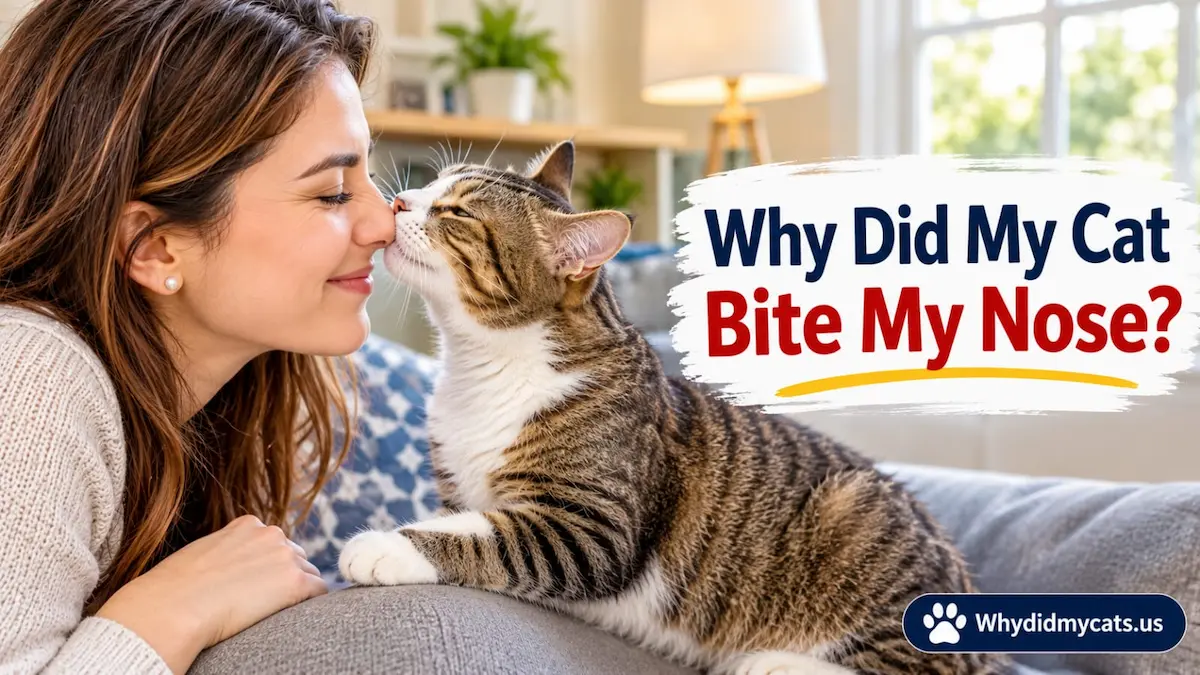
Why did my cat bite my nose? Most of the time it’s a love bite, a play nip, or a request for attention, and it’s soft enough that it barely registers. A hard bite that follows a flicking tail, flattened ears, or a hiss usually means she’s had enough. If the bite broke the skin, wash it right away and jump to the first-aid section below.
Soft Nibble or Real Bite? How to Tell the Difference
The pressure of the bite matters, but the moment right before it matters more. Here’s how the common patterns line up:
| What you notice | What it usually means | What to do |
| Light mouthing, no real pressure, relaxed body, slow blinks | Love bite or grooming | Enjoy it, or gently redirect |
| Quick nip as you lean in, wide eyes, pouncing | Play | Offer a wand toy |
| Nip at dawn while you’re half asleep | Attention or breakfast request | Don’t react; adjust the routine |
| Firmer bite after long petting, tail flicking, ears turning back | Overstimulation | Stop petting, give her space |
| Hard bite with flattened ears, hissing, or dilated pupils | Fear or a clear warning | Back away calmly |
| Bite that breaks the skin | Wound care needed | See the first-aid section |
Why Did My Cat Bite My Nose? 7 Likely Reasons
1. A Love Bite
Cats groom each other with licks and tiny nibbles, and a bonded cat may treat you the same way. A gentle nose nibble with purring and soft eyes is a compliment, not an attack. If she nips you in other spots too, our guide on why cats nip explains the pattern.
2. A Nose-to-Nose Hello
Cats greet each other by sniffing noses. Yours is the closest thing to a feline greeting spot, which is why a cat who bumps your face and then nibbles may just be saying hello with a little extra enthusiasm.
3. Play and Hunting Instinct
A nose that moves when you laugh, breathe, or turn your head looks a lot like prey. Kittens and young cats go for it most, and a teething kitten may chew anything that sits at face level. Don’t wrestle with her using your face or hands, since that teaches her your features are toys.
4. A Request for Attention or Food
Cats learn fast that a nose nip gets a reaction. If it happens when her bowl is empty or playtime is overdue, it’s likely a request. Reacting with a squeal or a lecture still counts as attention, which is exactly what she wanted.
5. Overstimulation During Cuddles
A cat can love a lap session and still hit her limit. Repeated strokes along the back or near the base of the tail build up until the nip arrives, usually after the warning signs: a twitching tail, ears rotating sideways, skin rippling along the back, or a sudden stillness. Stop petting when you see them, and the bite never happens.
6. Scent Marking
Cats rub their cheeks and heads on the people and things they consider theirs. If she rubs her face against yours and then nibbles your nose, it’s part of the same “you belong to me” routine.
7. A Warning or Fear
A bite with flattened ears, dilated pupils, a growl, or a hiss is a real “back off.” She’s frightened, cornered, or hurting. If this follows a hiss, our article on why a cat hisses at you covers what the warning means and how to respond.
Why Does My Cat Bite My Nose While Purring?
Because purring isn’t a happiness switch. Cats purr when they’re relaxed, but also when they’re stressed or uncomfortable, so the sound alone doesn’t settle anything. Look at the rest of her: loose limbs, soft eyes, and kneading point to contentment. A stiff body or twitching tail alongside the purr means she’s using it to cope, not celebrate.
Why Does My Cat Bite My Nose When I’m Sleeping?
Because your nose is often the only part of you sticking out from the covers, and cats are most active around dawn. She has probably figured out that a nip gets you out of bed.
The fix is on the routine side. Feed on a fixed schedule, and don’t hand over breakfast right after the bite, or she’ll learn the nip is the doorbell. Play with a wand toy before bed so she burns off energy, and shut the bedroom door if the early nipping continues. If she’s also decided your pillow is her new spot, see why a cat might randomly start sleeping with you.
Why Does My Cat Bite My Nose and Chin?
Both are easy to reach when your face is close to hers, so they often get the same treatment. The reasons are the same too, and we cover them in more detail in our article on why a cat bites your chin.
What to Do When Your Cat Bites Your Nose
- Stay calm and still. Jerking away can trigger a scratch.
- End the contact quietly. Stand up, turn your head, or set her down. Walking away works better than a scolding.
- Hand her a better target. A wand toy or a kicker toy gives her something to bite.
- Track the timing. Dawn, long cuddles, or an empty bowl each point to a different fix.
- Skip the shouting, spray bottles, and nose taps. They teach her to fear you, not to stop.
What If the Bite Breaks the Skin?
A love bite shouldn’t draw blood, so a puncture isn’t one. Cat teeth are thin and sharp, and the small wounds they leave close over quickly and can trap bacteria underneath. Infections can set in fast.
- Wash the wound with soap and warm running water for a few minutes, and press on it with a clean cloth if it’s bleeding.
- Call a doctor or urgent care the same day for any puncture on your face, since the nose is mostly cartilage and sits close to the eyes.
- Get care promptly for swelling, spreading redness, warmth, pus, or fever, and for any bite if you have a weakened immune system or diabetes.
- Ask about your tetanus shot, and mention it if the cat is a stray or her rabies vaccination status is unknown.
If children live in your home, teach them not to put their faces close to a cat’s mouth, and stay nearby when they play together.
When to Talk to Your Vet
A one-off nibble from a relaxed cat isn’t a medical issue. A change in pattern is worth a call: biting that starts out of nowhere in a cat who never did it, bites that get harder or more frequent, or a cat who flinches, hisses, or pulls away from touch she used to enjoy. Cats hide pain well, and dental disease or arthritis can make a normally easygoing cat irritable. Hiding, eating less, or litter-box changes alongside the biting make the visit more urgent. Your vet will usually check her mouth, joints, and general health before recommending behavior changes.
FAQs
How do you say no in cat language?
Cats don’t understand the word “no,” so the message has to be physical. Calmly stop what you’re doing, turn away, or set her down, and don’t give attention during the nip. Cats say no the same way: walking off, turning their heads, flattening their ears, or flicking the tail.
Why should you not stare a cat in the eyes?
A direct, unblinking stare can read as a threat or a challenge in cat language, especially to a nervous cat. Look away now and then, and try a slow blink instead, which tends to signal friendliness. Let her approach you rather than staring her down.
Do cats apologize for biting?
Not in the human sense. There’s no good evidence that cats feel guilt or say sorry. After a bite she may groom herself, retreat, or return for attention, which is usually her calming down. Focus on what set the bite off rather than waiting for an apology.
Do cats recognize humans as cats?
Probably not exactly. Cats use some behaviors on people that they use with other cats, like head rubbing, kneading, and licking, but they meow mostly at humans and rarely at each other. It’s likely they see us as close social partners, though no one knows for sure.
Do cats prefer female owners?
There’s no solid evidence that cats prefer women. Preferences tend to follow behavior: calm, patient, predictable people who let the cat approach and handle feeding and play usually win her over. A cat’s early experiences with different people also play a part.
Do cats care if you cry?
Cats notice when you’re upset because your voice, posture, and routine change, and many come closer or sit with you. Whether they understand sadness the way people do isn’t proven. What’s clear is that they respond to you, and your calm presence matters to them.
Conclusion
A nose bite is usually communication, not aggression. Soft nibbles with relaxed body language are affection, play, or a request, while hard bites after warning signs mean she wants space. End the interaction calmly, redirect to a toy, and adjust the routine that triggers it. Wash any bite that breaks the skin right away, and talk to your vet if the biting is new, escalating, or paired with other changes.
[…] Why Did My Cat Bite My Nose? How to Tell Affection From a Warning […]