
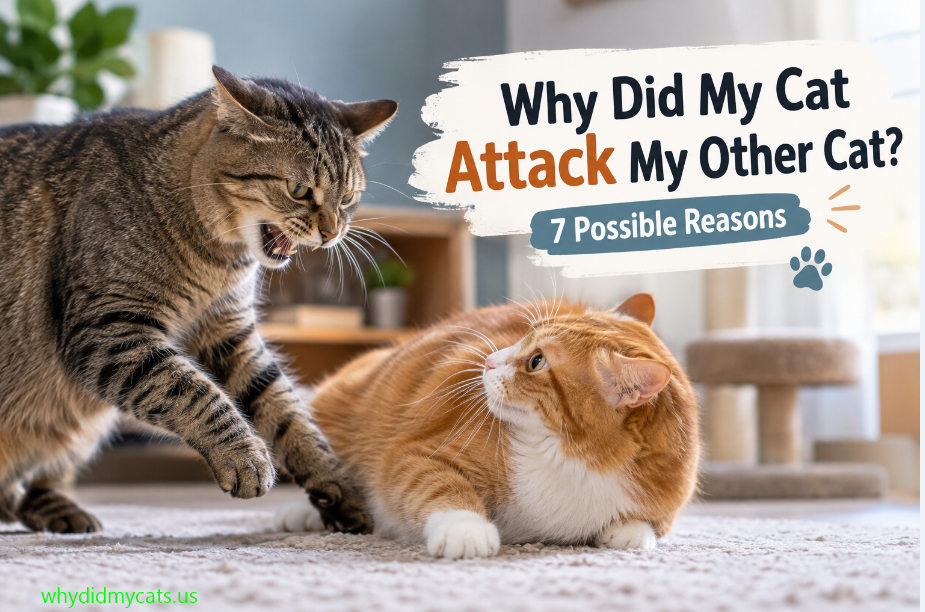
Watching one of your cats suddenly attack another can be frightening, especially when they used to sleep together, groom each other, or share the same couch peacefully.
The reason isn’t always obvious. Your cat might be reacting to fear, territorial tension, a stressful event, or even pain. Sometimes a cat sees another animal outside the window, becomes highly agitated, and redirects that frustration toward the housemate standing nearby.
The first step is to separate the cats safely. Once they’re calm, look at what happened before the attack and whether either cat has changed physically or behaviorally.
Why Did My Cat Attack My Other Cat for No Reason?
An attack that seems unprovoked often has a trigger you didn’t notice. For example, your cat might have spotted a neighborhood cat through the living room window earlier, heard a startling noise, or smelled an unfamiliar animal on someone’s clothing.
Cats can remain agitated after a frightening event. When the other household cat approaches, the upset cat may hiss, chase, or bite.
Think about the minutes leading up to the fight. Did one cat stare at the window, guard a doorway, chase the other away from a favorite spot, or react differently after a vet visit? These details can help you identify the cause.
7 Reasons Your Cat May Attack Another Cat
1. Redirected Aggression
Redirected aggression happens when a cat becomes upset by something it cannot reach and attacks a nearby animal instead.
Imagine your indoor cat sees a strange cat outside the patio door. Your cat becomes tense and starts growling. When your other cat walks over, the tension spills over into a fight.
This type of attack can appear completely random. Don’t approach or pick up an agitated cat; give both cats space and keep them separated until they’re calm.
2. Territorial Behavior
Cats may fight over territory, even when they’ve lived together for years. A favorite sleeping spot, a sunny windowsill, a feeding area, or access to a hallway can become a source of conflict.
A new pet, a move to another home, or rearranged furniture can also upset the balance. One cat might begin blocking doorways, staring at the other, or chasing them away from certain rooms.
Provide separate resting areas, food and water stations, hiding places, and litter boxes in different locations. This reduces the need for cats to compete for essential resources.
3. Fear or Stress
A frightened cat may attack to protect itself, particularly when it feels trapped or cannot escape.
Visitors, loud construction, children chasing a cat, or an unfamiliar animal entering the home can raise stress levels. The cat may then react defensively when its housemate comes too close.
Look for flattened ears, a crouched body, a tucked tail, growling, or repeated attempts to hide. Give the frightened cat a quiet room where it can rest without being approached.
4. Rough Play Gets Out of Hand
Young cats often chase, wrestle, pounce, and bite during play. The problem starts when one cat wants to continue and the other has had enough.
Play is usually more balanced: cats take turns chasing, pause between bouts, and return voluntarily. A real conflict is more concerning when one cat relentlessly pursues the other, while the victim hides, screams, or struggles to escape.
Schedule daily interactive play with a wand toy, especially for a high-energy cat that keeps ambushing a quieter housemate. Never use your hands to break up a fight.
5. Competition Over Food, Litter Boxes, or Attention
Two cats might get along in the living room but fight near their food bowls or when both want access to you.
For example, one cat might sit in front of the litter box entrance, making the other cat afraid to pass. These subtle conflicts can grow into chasing and biting.
Give each cat separate feeding spaces and easy access to litter boxes, water, resting spots, and elevated perches. In a multi-cat home, provide enough resources that one cat cannot easily guard them all.
6. Pain or an Underlying Health Problem
A normally friendly cat may become irritable when something hurts. Dental pain, arthritis, an injury, or another medical problem can change how a cat responds to ordinary interactions.
You might notice that your cat attacks when the other cat bumps into them, approaches while they’re resting, or touches a sensitive area. A change in appetite, movement, grooming, or energy can offer additional clues.
Arrange a veterinary examination when aggression starts suddenly, especially in cats that previously got along. Don’t assume the behavior is purely a personality problem.
7. Changes in Your Cats’ Relationship
Cats that once shared everything don’t always remain close. As kittens mature, their activity levels and social preferences can change. A new cat, an unfamiliar scent after a veterinary visit, or a long separation can also disrupt their relationship.
Sometimes the cat that starts the fight is not trying to establish permanent dominance; it simply feels uncomfortable around the other cat at that moment.
If your cat’s behavior has changed dramatically, our guide on why a cat may become aggressive all of a sudden covers additional signs and possible triggers.
Why Does My Cat Bite My Other Cat’s Neck?
Neck biting can happen during rough play, mating behavior, or an aggressive encounter. The surrounding body language helps distinguish these situations.
During play, cats usually alternate roles and have opportunities to disengage. During a fight, one cat might pin the other down, bite repeatedly, growl, or prevent the other cat from escaping.
An unneutered male may grab another cat’s neck during mating-related behavior. However, neck biting alone doesn’t prove that mating or dominance is the cause.
Check for puncture wounds, especially beneath the fur. Cat bites can leave small marks that are easy to miss but can become infected. Contact your veterinarian if a bite occurred, particularly if the skin was broken.
Why Does My Cat Bite My Other Cat While Grooming?
Grooming between cats can include gentle nibbling, licking, and brief playful bites. A cat might also become overstimulated and suddenly end the interaction with a nip.
Watch how the other cat responds. If both cats remain relaxed and willingly continue interacting, the biting may be part of normal social behavior. If one cat stiffens, flattens its ears, growls, swats, or tries to escape, end the interaction by calmly giving them space.
Repeated biting that turns into chasing or fighting deserves closer attention, particularly when it is a new behavior.
How to Tell Play Fighting From Real Fighting
| Play fighting | A real fight |
| Cats take turns chasing | One cat repeatedly pursues the other |
| Bodies appear relatively loose | Bodies become stiff or defensive |
| Pauses occur naturally | Growling, screaming, or intense hissing may continue |
| Both cats return voluntarily | One cat hides or tries desperately to escape |
These signs are helpful, but no single behavior guarantees that an interaction is safe. When you’re unsure, interrupt the situation without touching either cat.
What Should You Do After Your Cat Attacks Another Cat?
1. Separate them safely. Don’t reach between fighting cats or grab them with your bare hands. Use a solid barrier, such as a large piece of cardboard or a cushion, to block their view and create distance when it is safe to do so. Move them into separate rooms.
2. Let both cats calm down. Provide food, water, litter boxes, hiding places, and comfortable resting areas in their separate spaces. Don’t force them to face each other through a door or immediately resume contact.
3. Check for injuries. Look for bleeding, swelling, limping, or signs of pain without forcing a frightened cat to be handled. Contact a veterinarian promptly for bite wounds or other injuries. Heavy bleeding, breathing difficulty, collapse, or severe trauma requires emergency veterinary care.
4. Reintroduce them gradually. Once both cats are calm, begin with separate spaces and familiar scents. Later, offer positive experiences on opposite sides of a closed door, such as meals at a comfortable distance. Progress to brief, supervised visual contact only when both cats remain relaxed. Go back a step if either cat becomes tense.
5. Remove the trigger. If fights happen near food, separate the feeding stations. If a neighborhood cat triggers aggression through a window, block the view. Keep a brief record of when fights happen so you can spot patterns.
Never punish either cat or force them to “work it out.” Repeated fights can make their relationship worse.
When Should You Contact a Veterinarian?
Seek veterinary advice when aggression appears suddenly, keeps recurring, or involves a cat that seems painful or unwell. A vet can check for injuries and medical conditions that might be affecting behavior.
If the cats continue fighting despite separation and gradual reintroduction, ask your veterinarian about a qualified feline behavior professional. Persistent aggression may require an individualized behavior plan.
FAQs
How do I train my cat to stop attacking my other cat?
Start by preventing further fights and identifying the trigger. Give both cats separate resources, reward calm behavior, and use gradual reintroduction rather than forcing contact. Daily interactive play can help an energetic cat redirect its attention. If attacks continue, consult your veterinarian or a qualified feline behavior professional.
Do cats forgive each other after a fight?
Cats don’t necessarily understand forgiveness the way people do, but they can become comfortable around each other again. Some return to their usual relationship after a brief conflict; others need days or weeks of separation and gradual reintroduction. Let their behavior guide the pace instead of forcing them to interact.
Can a cat be traumatized after being attacked?
A cat may become fearful or stressed after an attack. You might notice hiding, avoiding the other cat, reduced appetite, or reluctance to enter certain rooms. Provide a safe, quiet space and avoid forced contact. If these changes persist or your cat stops eating, contact your veterinarian.
Why does my cat only attack one specific person?
Cats may react to a particular person’s movements, scent, voice, handling, or past interactions. Fear, overstimulation, and pain can also contribute. Observe what happens immediately before the attack and avoid punishment. Sudden or severe aggression warrants a veterinary check to rule out medical causes.
Conclusion
When your cat attacks your other cat, the cause may be fear, redirected aggression, territorial tension, rough play, or a health problem. Separate them safely, look for triggers, and don’t rush their reunion. With the right precautions and gradual reintroduction, many cats can learn to share their home more peacefully.
[…] If tension between household cats is involved, see why your cat attacks your other cat. […]